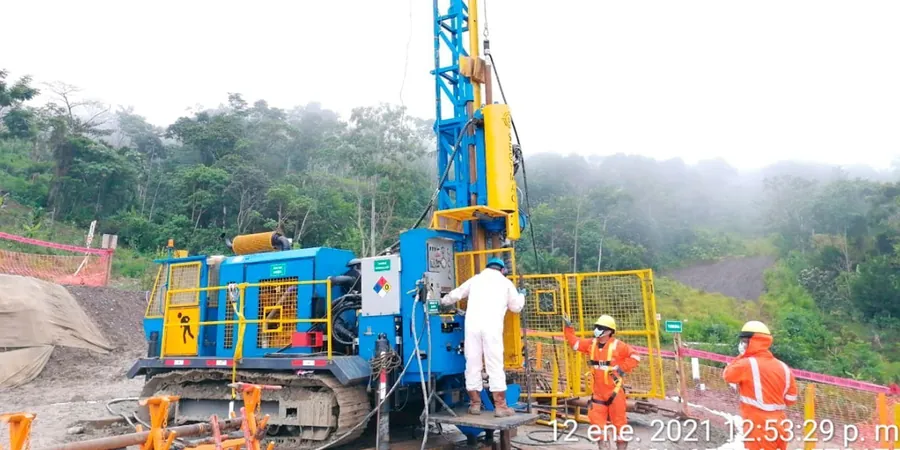
Toronto's subsurface is dominated by glacial tills, lake deposits, and variable fill from decades of urban development. The NBCC 2020 and CSA A23.2-9A / CSA A23.2-9A / CSA A23.2-9A / CSA A23.2-9A / CSA A23.2-9A / ASTM D1586 set the benchmark for in-situ testing here. For any project in Toronto, the SPT (Standard Penetration Test) remains the most direct method to estimate soil density and strength. It is especially relevant because the city sits on a mix of hard till and soft clay layers that require precise stratification. Before designing footings or deep foundations, we run SPT borings to correlate blow counts with bearing capacity. This data feeds directly into settlement calculations and liquefaction screening. When the profile includes sand lenses or silt seams, we complement the investigation with a resistivity survey to map groundwater and stratigraphy non-invasively.
The SPT (Standard Penetration Test) in Toronto provides the most direct measure of soil density in glacial tills, where lab sampling is often impossible.
Methodology and scope
In Toronto, we often encounter a hard crust of desiccated clay underlain by softer lacustrine deposits. The SPT (Standard Penetration Test) captures this transition with clarity. We follow CSA A23.2-9A / CSA A23.2-9A / CSA A23.2-9A / CSA A23.2-9A / CSA A23.2-9A / ASTM D1586 strictly — dropping a 63.5 kg hammer from 760 mm and recording N-values at 300 mm intervals. The results distinguish between dense till (N > 40) and soft clay (N < 10) within the same borehole. We also use energy correction factors (ERi) to normalize blow counts for different hammer systems. This is critical when correlating N-values to friction angle or modulus. For deep excavation projects, we integrate the SPT data with stability analysis of slopes to assess lateral earth pressures and basal heave risk.
Technical reference image — Toronto
Local considerations
Toronto's rapid post-war expansion buried stream valleys, filled ravines, and placed uncontrolled fill over soft organic layers. The 1954 Hurricane Hazel flood exposed how poorly compacted fill can liquefy or settle under saturation. Today, many downtown sites sit on former marshland where the SPT (Standard Penetration Test) is the only practical way to profile fill thickness and identify loose zones. Without reliable N-values, a foundation designed for stiff till may land on soft clay — leading to differential settlements of 50 mm or more. The cost of fixing that after construction far exceeds the price of a proper SPT investigation upfront.
How does the SPT differ from CPT in Toronto soils?
The SPT provides disturbed soil samples for classification and lab testing, while the CPT gives a continuous profile of tip resistance and sleeve friction. In Toronto's dense tills, the SPT is often preferred because the CPT cone can jam or deviate in gravelly layers. The SPT also delivers split-spoon samples for moisture content and fines content, which are critical for liquefaction assessment.
How much does an SPT investigation cost in Toronto?
The typical range for an SPT (Standard Penetration Test) in Toronto is CA$740 to CA$930 per borehole, depending on depth, number of tests, and site access. This includes mobilization, drilling, sampling, and a preliminary field log. Final laboratory testing and engineering analysis are billed separately.
What N-value indicates liquefaction risk in Toronto?
For clean sands, a corrected N-value (N1,60) below 15 indicates high liquefaction susceptibility under a magnitude 7.5 event. In Toronto's lacustrine deposits, the presence of fines (plastic silt) raises the threshold to N1,60 below 20. We apply the Youd-Idriss 2001 method to account for fines content and overburden stress.
Can SPT be performed in winter on frozen ground?
Yes, but it requires thawing the upper 1–2 m of frozen ground with steam or hot water before drilling. Toronto's winter temperatures often freeze the active layer to 1.5 m depth. We use a heated mud system to prevent freezing in the borehole and ensure consistent hammer drop. All rods and samplers are kept above freezing to avoid icing on the anvil.
Location and service area
We serve projects across Toronto and its metropolitan area.