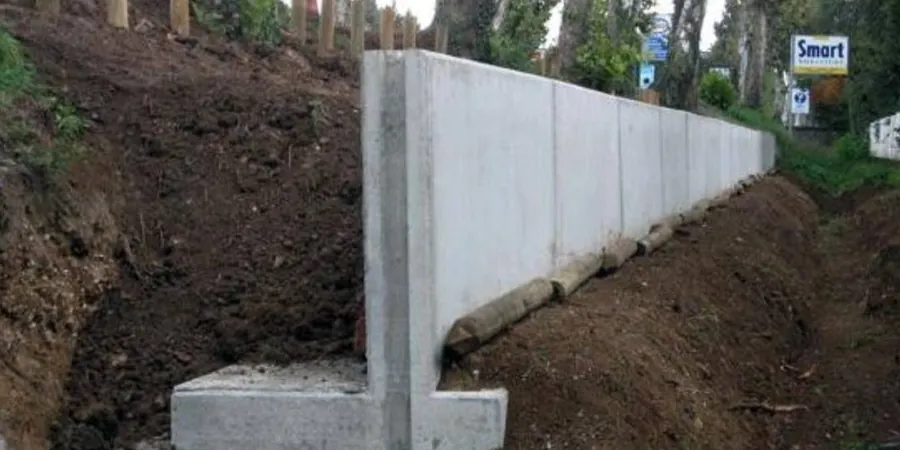
Toronto sits on 2.9 million people and a deep sequence of glacial till and lake-bottom clays. That geology makes retaining wall design in Toronto a specific discipline. The soil profile changes block by block. You can have stiff clay till one street and soft varved clay the next. Our team has worked through these conditions for years. We know when a conventional gravity wall works and when you need a reinforced system. Before we finalize any wall geometry we run a resistividad eléctrica SEV survey to map soil layers without drilling everywhere. That saves time and money. The goal is a wall that resists lateral earth pressure, hydrostatic pressure, and frost heave. We design for long-term performance.
In Toronto clay till, a properly drained retaining wall outlasts an undrained one by decades. Drainage is the difference.
Methodology and scope
Toronto's development boomed after the 1950s. Many neighborhoods sit on filled ravines or former lakebeds. That legacy means retaining wall design in Toronto must account for variable fill thickness and hidden drainage paths. We follow the NBCC 2020 and CSA A23.3-19 for load combinations and concrete design. Our parameters include active and at-rest pressures, surcharge loads from traffic or buildings, and seismic coefficients for the Lake Ontario region. We also check global stability. For deeper excavations we pair the wall with estabilidad de taludes analysis to ensure the whole slope holds. Every design includes a drainage layer behind the wall. Without it hydrostatic pressure builds fast in clay soils. We size weep holes and filter fabric to prevent clogging.
Technical reference image — Toronto
Local considerations
In Toronto, many times we see walls fail because nobody checked the groundwater. The city has a high water table in spring. Combine that with clay that holds moisture and you get hydrostatic pressure behind the wall. Another common issue is frost depth. Toronto's frost line goes 1.2 m deep. If the wall footing sits above that, freeze-thaw cycles push the wall out. We always design with a frost-protected footing or a drainage blanket that extends below the frost line. The third risk is poor backfill compaction. Loose fill behind the wall settles and adds lateral load. We specify select granular backfill and compaction to 95% Standard Proctor.
We design gravity walls using mass concrete or segmental blocks for heights up to 3 m. For taller walls we switch to cantilever reinforced concrete. We calculate sliding, overturning, and bearing capacity using Toronto soil parameters. Every design includes a drainage layer and frost protection.
02
Reinforced Soil and MSE Wall Design
For heights above 4 m or poor foundations we use mechanically stabilized earth (MSE) walls. We design with steel or geosynthetic reinforcements. The system uses the on-site till as fill when possible, reducing import costs. We check internal and external stability per FHWA and CSA standards.
What is the typical cost range for retaining wall design in Toronto?
For a standard residential or small commercial wall, design fees range between CA$1,620 and CA$4,940. The exact cost depends on wall height, soil investigation needs, and drainage complexity. We provide a fixed-price quote after reviewing the site conditions.
How deep should the footing be for a retaining wall in Toronto?
The footing must sit below the local frost line, which is 1.2 m in Toronto. For walls on clay till we also consider bearing capacity. We typically design footings at 1.3 to 1.5 m depth to account for frost heave and provide a safety margin.
Do I need a soil report before designing a retaining wall in Toronto?
Yes. The NBCC 2020 requires a geotechnical investigation for walls over 1.5 m in height. We need soil type, shear strength, groundwater level, and compaction data. Without a report we cannot certify the design. We can coordinate the soil testing if you don't have it yet.
Location and service area
We serve projects across Toronto and its metropolitan area.