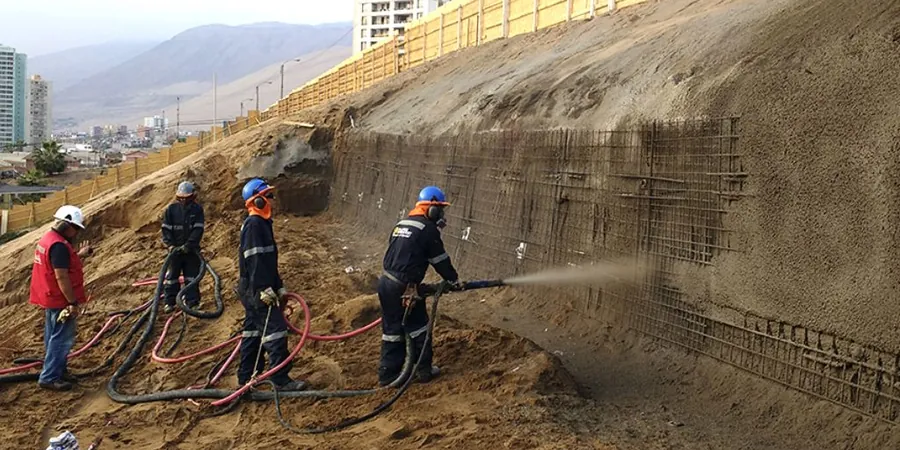
Toronto’s deep glacial till and the soft lacustrine clays of the former Lake Iroquois basin create a tricky foundation for any hillside. When spring thaws hit the Scarborough Bluffs, we see how quickly saturated soils can turn a stable slope into a liability. That’s why our slope stability analysis in Toronto starts with a detailed review of local stratigraphy, combining borehole data with shear strength testing. We follow the FHWA-NHI-05 manual for limit equilibrium methods, and we always cross-check with the Ontario Building Code provisions. Before excavating near a ravine, it pays to run a resistivity survey to map hidden water tables. That data feeds directly into our factor of safety calculations.
In Toronto till, a saturated slope can lose 40% of its shear strength — we've seen failures happen overnight after a heavy spring rain.
Methodology and scope
The difference between a stable ravine lot in Rosedale and a problem site in the Don Valley often comes down to one thing: the presence of perched water tables in the sand layers. We’ve seen it time and again. Our team runs direct shear tests on undisturbed samples and uses Bishop’s simplified method for rotational failure surfaces. For projects on the Lake Iroquois shoreline, we also model seepage forces with finite element software. When a client is planning a cut near a creek, we recommend pairing the analysis with a geocell reinforcement solution to manage surface erosion. Key parameters we check:
Effective cohesion (c') — typically 5–15 kPa in Toronto till
Friction angle (phi') — ranges from 30° to 38° in dense glacial deposits
Pore pressure ratio (ru) — critical during wet seasons
Factor of safety target — minimum 1.5 for static, 1.1 for seismic per NBCC
Technical reference image — Toronto
Local considerations
In Toronto, many times we see that the biggest risk isn't the soil itself — it's the buried infrastructure. Old water mains leaking for years can saturate a slope from inside, creating a slow-motion failure. One project near the Humber River had a 20-meter slope that looked stable until we drilled and found a perched water table fed by a cracked storm sewer. That’s why our slope stability analysis in Toronto always includes a site walk with utility records. We also look at freeze-thaw cycles: the clay layers in the Don Valley can lose up to half their strength after a hard winter. Skipping this step means you're gambling with the structure above.
We model circular and non-circular failure surfaces using Bishop, Janbu, and Spencer methods. Output includes factor of safety for static, seismic, and rapid drawdown conditions. We calibrate models with local till strength data from 200+ projects in the GTA.
02
Finite Element Seepage & Stability (FEM)
For complex sites with layered soils and water tables, we run coupled seepage-deformation models. This is particularly useful for ravine lots in North York where perched water tables are common. We provide pore pressure contours and deformation plots.
How much does a slope stability analysis cost in Toronto?
For a typical residential or small commercial project, you can expect a range between CA$1.570 and CA$4.860. The final figure depends on site complexity, number of boreholes, and whether we need CU triaxial tests. We always provide a clear scope before starting.
What factor of safety does the Ontario Building Code require for slopes?
The NBCC 2020, adopted by Ontario, mandates a minimum factor of safety of 1.5 for static loading and 1.1 for seismic. For critical infrastructure like bridges or hospitals, we often target 1.3 for seismic. Our reports explicitly state the code clause used.
Do I need a slope analysis for a house built near a ravine in Toronto?
Yes. The City of Toronto's Ravine and Natural Feature Protection bylaw requires a geotechnical assessment for any development within 30 meters of a ravine edge. We've done dozens of these along the Don Valley and Humber River. The report must demonstrate that the proposed construction won't reduce the factor of safety below 1.5.
What's the difference between Bishop's method and Spencer's method for slope stability?
Both are limit equilibrium methods, but Spencer's satisfies all force and moment equilibrium, while Bishop's simplified only satisfies moment equilibrium for circular slips. For Toronto's layered till where failure surfaces may be non-circular, we prefer Spencer's. For simple fills, Bishop's is usually sufficient.
Location and service area
We serve projects across Toronto and its metropolitan area.