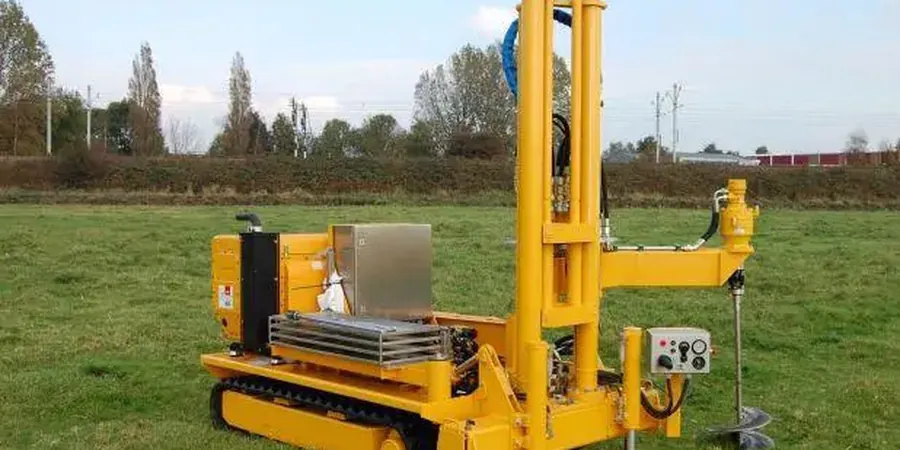
Toronto's urban expansion since the 1950s has pushed development onto the Lake Ontario shoreline and former glacial lake plains. The deep deposits of soft clay and silt—known as the Lake Iroquois clay—pose unique challenges for foundation design. A Cone Penetration Test (CPT) provides a continuous profile of soil behavior type, cone resistance, and sleeve friction. It is the preferred method for mapping the variable stratigraphy of the Toronto till and underlying glaciolacustrine layers. Before designing deep foundations in the downtown core, engineers often combine CPT with a resistividad eléctrica SEV to detect groundwater anomalies, or with asentamientos analysis to predict long-term consolidation under high-rise loads.
CPT provides a continuous profile of cone resistance and pore pressure, capturing thin lenses that SPT alone would miss in Toronto's lacustrine clays.
Methodology and scope
CPT in Toronto follows ASTM D5778-20 and the Canadian Foundation Engineering Manual (CFEM 2021). The cone penetrometer measures tip resistance (qc) and sleeve friction (fs) at 20 mm intervals. This resolution captures thin sand lenses within the clay matrix—critical for liquefaction screening under NBCC 2020 seismic provisions. The electric piezocone (CPTu) also records pore pressure (u2) to identify drainage conditions. Key parameters derived include:
Soil Behavior Type (SBT) via Robertson chart
Undrained shear strength (Su) in clays
Friction ratio (Rf) for layer identification
Overconsolidation ratio (OCR) from pore pressure dissipation tests
For projects in the Port Lands or Scarborough Bluffs, CPT data is paired with ensayo SPT to correlate continuous profiles with discrete samples for geotechnical design.
Technical reference image — Toronto
Local considerations
Toronto lies in seismic zone 0 (NBCC 2020 Sa(0.2) ≈ 0.20 g), yet the thick soft clays amplify long-period motions. The 2010 Leamington earthquake (M4.8) was felt across the GTA, reminding engineers that liquefaction is possible in loose sand layers within the Don Valley and lower Humber River floodplains. CPT data directly feeds the Youd-Idriss (2001) liquefaction evaluation method, providing the continuous qc profiles needed to identify critical layers. The city's population exceeds 2.9 million, and with high-rise construction on variable glacial deposits, a detailed CPT campaign reduces the risk of differential settlement during seismic events.
0.5 – 25 MPa (typical for Toronto clays and sands)
Sleeve friction (fs)
10 – 250 kPa
Pore pressure (u2)
0 – 3000 kPa (piezocone)
Friction ratio (Rf = fs/qc)
0.1% – 5% (clay to sand)
Penetration rate
20 mm/s ± 5 mm/s per ASTM D5778
Depth range
Typically 15 – 40 m in GTA projects
Associated technical services
01
Piezocone (CPTu) with Pore Pressure Dissipation
Continuous measurement of cone resistance, sleeve friction, and pore pressure. Dissipation tests provide in-situ hydraulic conductivity and consolidation parameters for fine-grained soils typical of the Toronto lakefill areas.
02
Seismic CPT (SCPT) for Shear Wave Velocity
Addition of a geophone array to measure Vs. Direct input for NBCC 2020 site class classification and liquefaction triggering analysis in the Don River and Humber River valleys.
Applicable standards
ASTM D5778-20 (Standard Test Method for Electronic Friction Cone and Piezocone Penetration Testing), Canadian Foundation Engineering Manual (CFEM) 2021, NBCC 2020 – Seismic provisions for site class determination
Frequently asked questions
How deep can a CPT reach in Toronto soils?
Standard CPT rigs reach 40 m in most Toronto soils. The overconsolidated clay till near the surface can cause refusal earlier, but the St. Lawrence Seaway clay allows deeper penetration. We assess refusal risk from adjacent borehole data before mobilizing.
What is the typical cost range for a CPT in Toronto?
Cost for a single CPT sounding in Toronto ranges from CA$220 to CA$310 per linear meter. Volume discounts apply for multi-sounding campaigns on large GTA projects. Mobilization fees vary by site access.
How does CPT data help with liquefaction assessment in Toronto?
CPT provides continuous qc and Rf profiles used in the Robertson (2009) and Youd-Idriss (2001) methods. In Toronto, loose sand layers within the Don Valley fill and lower Humber floodplain are the primary targets. The piezocone identifies saturated zones critical for cyclic softening evaluation.
Can CPT replace SPT for foundation design in Toronto?
CPT offers superior resolution for stratigraphy and in-situ properties, but it does not retrieve soil samples. For projects requiring grain-size analysis or Atterberg limits, we recommend CPT for profiling and SPT for sampling at key depths. The two methods complement each other in Toronto's variable glacial deposits.
Location and service area
We serve projects across Toronto and its metropolitan area.