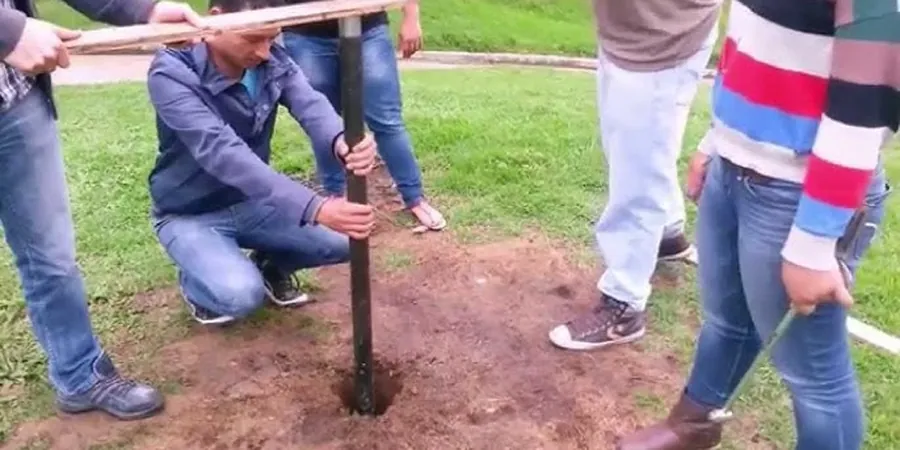
The National Building Code of Canada (NBCC 2020) requires that foundation design for soft cohesive soils be based on measured undrained shear strength. In Toronto, where glacial Lake Iroquois clay and silty clay deposits reach depths of over 20 meters in areas like the Humber River valley and the Don Valley, the field vane shear test (VST) is the most reliable in-situ method for obtaining these values. ASTM D2573-19 governs the procedure, ensuring consistent torque measurement at controlled rotation rates. Before designing deep foundations or assessing slope stability in these low-strength soils, a VST campaign is often combined with CPT soundings to correlate cone resistance with vane-determined strength, and with a full geotechnical site investigation to capture stratigraphic variability.
In Toronto's glacio-lacustrine clays, the field vane test provides the most direct measurement of undrained shear strength — critical for safe foundation design in soft ground.
Methodology and scope
Toronto's subsurface is dominated by the Thorncliffe Formation — stiff to hard silty clay tills interbedded with soft glacio-lacustrine clays. The VST is especially effective in these soft layers, where triaxial tests on undisturbed samples can miss the true in-situ undrained strength due to sampling disturbance. The test provides a direct measurement of peak and remoulded shear strength, from which sensitivity ratios are calculated. This is critical for excavations in the Lower Don Lands or along the Lake Ontario shoreline, where construction requires accurate assessment of the post-peak strength loss. For projects involving retaining walls designed to resist lateral earth pressures, the VST data feeds directly into the analysis of stability of retaining walls. The test also supports the evaluation of pavement subgrade performance when soft clay layers are encountered beneath road corridors. Parameters typically reported include:
Technical reference image — Toronto
Local considerations
The seasonal water table fluctuation in Toronto — rising up to 1.5 meters after snowmelt — can reduce effective stress in the upper clay crust, lowering the measured vane torque. Testing during dry periods may overestimate the undrained strength available during wet construction seasons. Additionally, the presence of thin sand or silt laminations within the clay, common in the Scarborough Formation, can create preferential drainage paths during vane rotation, producing artificially high strength readings. The risk is that an engineer designs for a factor of safety based on a dry-weather VST profile that does not represent the saturated condition. A minimum of three VSTs per soil unit is recommended, and results should always be compared with lab fall-cone or unconfined compression tests on tube samples.
Single borehole or probe hole with vane tests at 1 m intervals through soft clay strata. Includes digital torque recording, peak and remoulded strength, sensitivity calculation, and a field log with depth vs. shear strength plot. Ideal for small residential or low-rise commercial projects in the Don Valley or along the Lake Ontario shoreline.
02
Multi-borehole VST Campaign (6+ points)
For larger developments — mid-rise buildings, bridge abutments, or embankments — we execute a grid of VSTs across the site. Every test is geo-referenced, and we provide a 3D shear strength model interpolated between test locations. This service is common for sites in the Humber River floodplain or near the Toronto Harbour.
03
VST for Slope Stability & Embankment Design
Dedicated testing along planned cut slopes or embankment alignments. Tests are performed at critical depths identified by preliminary CPT profiles. The remoulded strength is especially important for quantifying post-construction strength loss. Results are delivered with a sensitivity contour map to identify zones prone to progressive failure.
Applicable standards
ASTM D2573-19 — Standard Test Method for Field Vane Shear Test in Saturated Fine-Grained Soils, NBCC 2020 — Division B, Part 4: Geotechnical design requirements for building foundations, Ontario Provincial Standards OPSS 1010 — Material specification for geotechnical investigation, CSA A23.3-19 — Design of concrete structures (relevant for foundation design using VST data)
Frequently asked questions
At what depth range can the field vane shear test be performed in Toronto's clay soils?
The VST is effective from about 0.5 m to a maximum of 30 m below ground surface, depending on the drilling method. In Toronto, most soft clay layers are encountered between 3 m and 18 m, so the standard vane rod length of 20 m is sufficient for the vast majority of projects. For deeper testing, extension rods can be added, but torque losses due to rod friction become significant beyond 25 m.
How does the VST differ from a triaxial test on a Shelby tube sample?
The VST measures undrained shear strength in-situ, preserving the natural stress state, fabric, and fissures of the clay. A triaxial test on a tube sample, by contrast, is subject to sampling disturbance — stress relief during extraction and handling can reduce the measured strength by 10 to 30 percent. In sensitive Toronto clays, the VST is considered the reference method for peak undrained strength, while triaxial tests are used to verify the stress-strain response under controlled boundary conditions.
What is the typical cost range for a field vane shear test in Toronto?
For a standard VST profile with 5 test points in a single borehole, the cost typically ranges between CA$820 and CA$1,760, depending on site accessibility, depth, and the number of mobilization days. Multi-borehole campaigns benefit from reduced per-test rates. These prices include the calibrated equipment, digital data acquisition, and a certified report. Additional charges apply for overnight site security or traffic control in urban streets.
Can the VST be performed in frozen ground or during winter in Toronto?
Yes, but with limitations. The vane can penetrate frozen crust only if a pilot hole is drilled through the frozen layer using a rock roller bit. Once below the frost line — typically 1.2 m in Toronto — the test proceeds normally. However, the frost itself may have artificially stiffened the upper clay, so VST results above 1.5 m should be interpreted with caution. Winter testing is common for schedule-sensitive projects, but we recommend adding a 15 percent safety margin to VST results from the top 2 m during freeze-thaw periods.
Location and service area
We serve projects across Toronto and its metropolitan area.