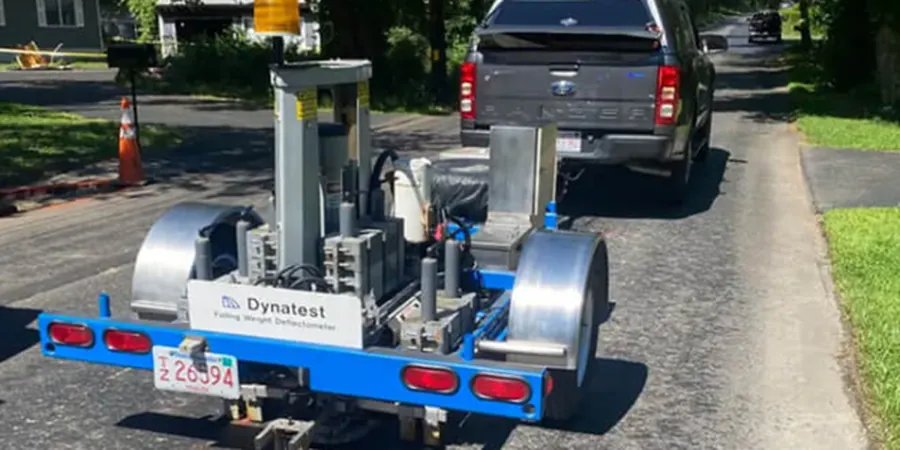
A stretch of Lake Shore Boulevard West near the Gardiner Expressway shows the reality of Toronto's aging road network: a 25-year-old asphalt section with transverse cracking every 12 meters and localized rutting reaching 15 mm in the outer wheel path. For any rehabilitation project on this city's arterial corridors, the existing pavement evaluation must go beyond visual surveys. We combine Falling Weight Deflectometer (FWD) testing with full-depth coring to measure layer moduli and remaining structural capacity. Before recommending an overlay thickness, we cross-reference deflection basins with subgrade conditions derived from borehole logging and SPT and laboratory resilient modulus tests on recovered samples.
A pavement with zero surface cracks can still have a structural number 40% below design if the base layer is saturated and the subgrade CBR has dropped from 8 to 3.
Methodology and scope
One mistake we often see from contractors in Toronto is assuming that a pavement in good surface condition has adequate structural support. The subgrade here, typically glacial till over shale bedrock, varies significantly in stiffness across short distances. A proper existing pavement evaluation addresses five key aspects: (1) structural capacity via FWD deflection analysis using AASHTO 1993 empirical models; (2) layer thickness and material identification from 150-mm-diameter cores; (3) subgrade California Bearing Ratio (CBR) from undisturbed samples; (4) drainage conditions and groundwater influence; and (5) fatigue cracking potential from traffic loading. We also integrate resistivity surveys to map moisture variations beneath the pavement structure, which directly affect subgrade support in freeze-thaw cycles typical of Toronto winters.
Technical reference image — Toronto
Local considerations
In Toronto, the most frequent risk we see is pavement failure within 3 years of a mill-and-overlay treatment because the existing granular base was never evaluated. If the base has degraded from 300 mm to 200 mm of effective thickness due to pumping or frost action, a simple 50 mm overlay does not restore structural capacity. Our existing pavement evaluation identifies those compromised layers through coring and DCP testing, so the design accounts for full-depth repairs where needed. Ignoring this step leads to reflective cracking, differential settlement at utility cuts, and premature maintenance cycles that cost the city or private owner three times the initial budget.
We perform FWD testing at 20 m intervals on urban roads and 50 m on highways, with load levels up to 60 kN to simulate standard axle loads. Deflection basins are backcalculated using layered elastic theory to determine in-situ layer moduli for asphalt, base, and subgrade.
02
Full-Depth Coring and Material Characterization
100 mm and 150 mm diameter cores are extracted at representative locations to measure layer thickness, asphalt binder content, air voids, and base gradation. Lab tests include resilient modulus, CBR, and moisture-density relationships per ASTM and AASHTO standards.
03
Traffic Loading Analysis and Remaining Life
We combine deflection data with traffic counts and axle load spectra to calculate the remaining structural number (SN) and predict fatigue life. The output is a recommended overlay thickness or full-depth repair strategy aligned with Ontario's pavement design methodology.
Applicable standards
ASTM D4694-09 (Standard Test Method for Deflections with a Falling Weight Type Impulse Load Device), ASTM D5858-96 (Standard Guide for Calculating In Situ Equivalent Elastic Moduli of Pavement Materials Using Layered Elastic Theory), AASHTO T 307-99 (Resilient Modulus of Unbound Materials), OPSS 351 (Ontario Provincial Standard Specification for Pavement Design and Rehabilitation)
Frequently asked questions
How long does an existing pavement evaluation take for a typical Toronto arterial road?
For a 2 km stretch, field testing (FWD and coring) usually takes 2 to 3 days, followed by 7 to 10 working days for lab testing and backcalculation. A full report including rehabilitation options is delivered within 3 weeks from mobilization.
What is the difference between FWD and Benkelman Beam for pavement evaluation?
The FWD applies a dynamic impulse load that simulates a moving truck at 40 to 60 kN, recording deflections at up to 7 sensor positions. The Benkelman Beam measures static rebound deflection under a slow-moving axle. FWD provides a more complete deflection basin, which allows backcalculation of individual layer moduli, while the Beam only gives a single surface deflection value.
How much does an existing pavement evaluation cost in Toronto?
The typical range for a full evaluation including FWD testing, coring, lab work, and a rehabilitation design report is between CA$1.490 and CA$4.590 depending on project length, number of cores, and traffic management requirements. Larger volumes reduce the per-meter cost.
Can you evaluate a pavement on a clay subgrade in the Don Valley area?
Yes. Clay subgrades in the Don Valley and lower Don watershed have CBR values as low as 2 to 4 and high plasticity. Our evaluation accounts for moisture-sensitive subgrades by measuring resilient modulus at multiple moisture contents and recommending drainage improvements or subgrade stabilization before overlay.
What pavement distresses require a structural evaluation instead of just patching?
Any distress that suggests structural failure should trigger a full evaluation: alligator cracking over more than 15% of the wheelpath area, rutting deeper than 15 mm, edge cracking with base loss, pumping fines at joints, or two or more patches in a 50 m section. Surface treatments alone will not solve these problems.
Location and service area
We serve projects across Toronto and its metropolitan area.