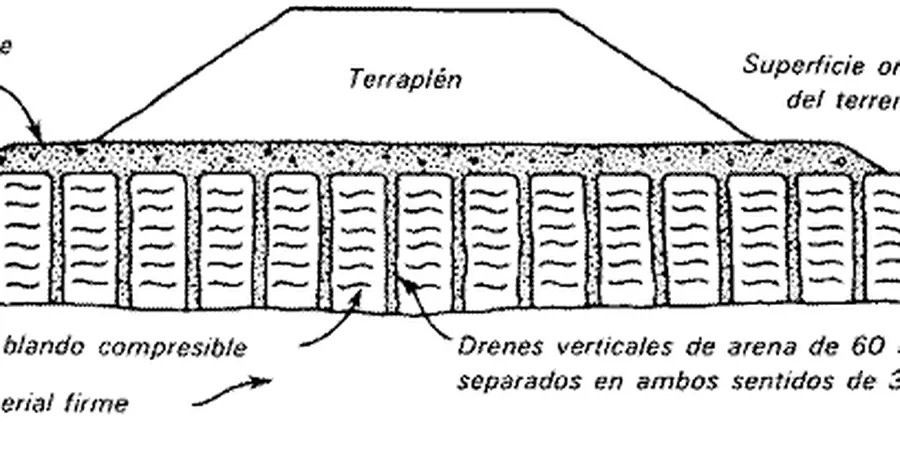
A typical PVD installation spreads a geotextile-wrapped band drain across a Toronto development site using a specialized mast rig that pushes the drain 15 to 30 meters into the soft clay. The mandrel advances at a controlled rate to minimize soil disturbance around the wick. Between each insertion the crew logs depth, spacing, and tip resistance. This field data directly feeds the design model. Before we finalize any layout we run a detailed study of soil mechanics to map stratigraphy and identify compressible layers. Toronto’s thick glacial till and Lake Iroquois clay require drain spacings between 1.2 and 2.0 meters to achieve 90 percent consolidation within the contractor’s schedule.
Spacing the prefabricated vertical drains too far apart is the most common design error on Toronto clay — it can double the consolidation time.
Methodology and scope
Our design follows the NBCC 2020 commentary on ground improvement and CSA A23.3 for any structural interface. Toronto’s high-plasticity clays (CH) demand careful evaluation of smear zone effects and well resistance. We use Hansbo’s radial consolidation theory coupled with finite-element seepage analysis. The parameters we fine-tune include drain discharge capacity (typically 100 to 300 m³/yr for a 100 mm wide band), mandrel cross-section influence, and vacuum preloading when the site has a high water table. In areas where lateral movement is a concern we combine the PVD design with a stability analysis of slopes to verify embankment stability during staged construction. The design report also specifies the minimum sand blanket thickness (0.5 m) and the drainage blanket permeability requirements.
Technical reference image — Toronto
Local considerations
The most frequent mistake we see on Toronto projects is assuming a uniform drain spacing across the entire site. In reality the thickest clay pockets near the Don River valley require tighter spacing than the thinner deposits on the Scarborough bluffs. Contractors who skip a site-specific PVD design often end up with differential settlements of 100 to 200 mm across the slab. The remediation cost — drilling through the completed fill and retrofitting wick drains — easily exceeds the original engineering fee. A proper prefabricated vertical drain design that accounts for local stratigraphy variability prevents this entirely.
Hansbo and Barron solutions calibrated to site-specific oedometer data. We output time-settlement curves for 50, 90, and 95 percent consolidation stages.
02
Smear Zone Assessment
Laboratory and field evaluation of the disturbed zone around the mandrel. We adjust the horizontal permeability reduction ratio (kh/ks) from 1.5 to 4.0.
03
Vacuum Preloading Integration
Design of vacuum pressure distribution through the sand blanket and PVD grid. Suitable for Toronto sites with a high water table where fill height is restricted.
Applicable standards
NBCC 2020 – Part 4 & Commentary on Ground Improvement, ASTM D6916 – Test Method for Vertical Strip Drains, CSA A23.3 – Design of Concrete Structures (interface elements)
Frequently asked questions
What is the typical prefabricated vertical drain spacing for Toronto clay?
For the soft lacustrine clay found across most of Toronto, spacings range from 1.2 to 2.0 m on a triangular grid. Tighter spacing (1.2 m) is used near the Don Valley where clay thickness exceeds 20 m, while 1.8 to 2.0 m works on the thinner deposits.
How long does consolidation take with PVDs in Toronto?
With a properly designed prefabricated vertical drain system, 90 percent consolidation in Toronto clay typically occurs within 4 to 8 months. Without drains the same settlement could take 10 to 20 years.
What is the cost range for a prefabricated vertical drain design in Toronto?
A complete PVD design for a typical Toronto development site ranges between CA$1,020 and CA$3,350. The final figure depends on site area, number of stratigraphy zones, and whether vacuum preloading is included.
Does the NBCC 2020 require PVD design for all soft clay sites?
The NBCC 2020 does not mandate PVDs specifically, but its commentary on ground improvement requires that any foundation on compressible soil must address post-construction settlement. PVDs are the standard solution when the clay layer exceeds 8 m and surcharge fill alone cannot achieve consolidation within schedule.
Location and service area
We serve projects across Toronto and its metropolitan area.