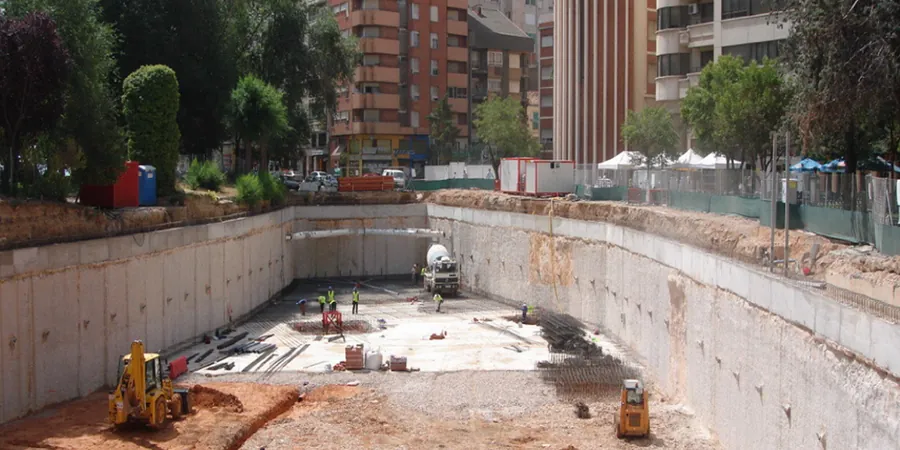
Toronto’s geology shifts dramatically between the Don Valley and the Scarborough Bluffs. In the downtown core, we often encounter dense glacial till overlying Georgian Bay shale. Out near Etobicoke, the soils are softer, with thicker layers of lacustrine clay. That contrast matters when designing a diaphragm wall. We need stiffness in the till and careful slurry control in the clay. Before we finalize the wall geometry, we typically run a resistivity survey to map the soil profile and check for boulders that could disrupt panel alignment. That data feeds directly into the structural model.
In Toronto till, diaphragm wall panels must key at least 1.5 m into the shale to prevent base heave under excavation.
Methodology and scope
The Great Lakes moderate Toronto’s temperature, but freeze-thaw cycles still affect concrete curing for diaphragm wall panels. We pour during the warmer months when possible, using low-heat cement mixes to avoid thermal cracking. The wall must resist both lateral earth pressure and groundwater seepage from the Lake Ontario water table. We design for a service life of 75 to 100 years. For projects near the waterfront, we couple the diaphragm wall with a drainage system to control uplift. The table below summarizes key parameters we verify during design.
Technical reference image — Toronto
Local considerations
The biggest risk we see in Toronto is loss of slurry during panel excavation through fractured shale. That can cause sudden ground loss and settlement in adjacent streets or utilities. We mitigate it by pre-treating the rock with a bentonite-cement grout before digging. Another recurring issue is the presence of cobbles and boulders in the till that jam the clamshell grab. We keep a chisel tool on site for that. A third common failure is improper guide wall alignment. If the guide walls shift even 20 mm, the panel may not fit the structural grid, forcing a redesign.
Boreholes to 30 m depth, SPT, and pressuremeter tests to determine lateral earth pressures and rock strength.
02
Slurry Mix Design and Testing
Laboratory formulation of bentonite and polymer slurries to ensure trench stability during excavation.
03
Structural Wall Modeling
Finite element analysis using PLAXIS 2D/3D to verify bending moments, deflections, and global stability.
Applicable standards
NBCC 2020 (National Building Code of Canada), CSA A23.3-19 (Design of Concrete Structures), CSA A23.2-9A / CSA A23.2-9A / CSA A23.2-9A / CSA A23.2-9A / CSA A23.2-9A / ASTM D1586 (SPT), ASTM D4380-12 (Density of Slurry), FHWA-NHI-10-024 (Diaphragm Wall Manual)
Frequently asked questions
How deep can a diaphragm wall go in Toronto soil conditions?
We have designed walls reaching 35 m in the downtown core, where the shale provides a competent bearing stratum. In areas with deep clay deposits, such as North York, depths are limited to around 20 m due to softer conditions and higher groundwater pressures.
What is the typical cost range for diaphragm wall design in Toronto?
The cost for design and testing typically falls between CA$2,340 and CA$9,070, depending on wall depth, panel quantity, and site access constraints. This includes soil investigation, slurry testing, and structural analysis.
Do you need a permit for diaphragm wall construction in Toronto?
Yes, a building permit is required under the Ontario Building Code. You will also need a shoring plan approved by the City’s Engineering Division, especially if the excavation exceeds 5 m in depth or is near existing structures.
What slurry type is best for Toronto’s shale and till?
We recommend a polymer-based slurry for the till layers because it reduces bentonite cake buildup on the rock face. For sections through the shale, a conventional bentonite slurry with a Marsh funnel viscosity of 35 to 40 seconds works well.
Location and service area
We serve projects across Toronto and its metropolitan area.