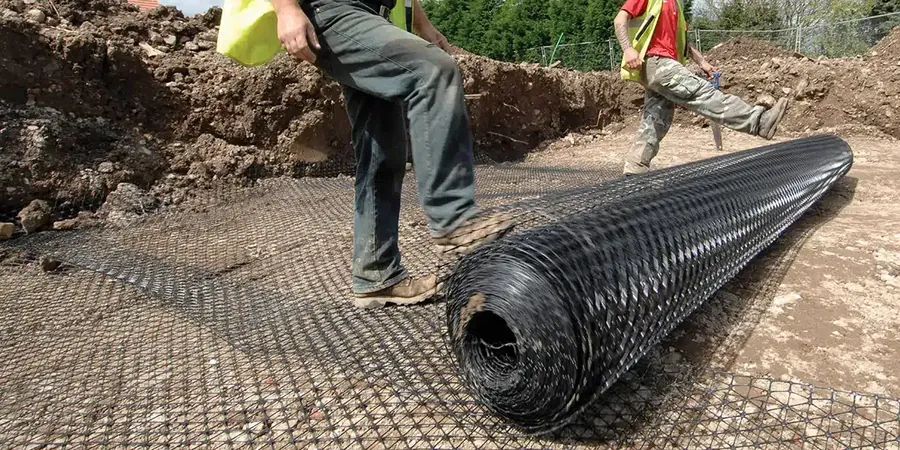
Toronto sits on a mix of glacial till, lacustrine clay, and shale bedrock, so geogrid specification must match each subsurface condition precisely. We follow ASTM D6637-18 for tensile testing and CSA S6:19 for reinforced soil structures. The city's freeze-thaw cycles and high water table in areas like the Don Valley demand careful selection of aperture size and polymer type. A poorly specified geogrid can lead to differential settlement or slope failure within two to three winters. That is why we define the design tensile strength, junction efficiency, and creep reduction factor based on site-specific data rather than generic tables. Each recommendation is tied to the actual soil profile encountered in Toronto, not assumed from regional averages.
A geogrid specified for Toronto glacial till must resist creep under 30+ years of freeze-thaw cycles — no generic design table can guarantee that.
Methodology and scope
Many Toronto projects overlook the interaction between geogrid and the underlying clay till. We always check the pullout resistance using direct shear tests on representative samples. The sequence matters: first we run a granulometry to classify the base aggregate, then we evaluate the asentamientos expected under repeated loading. Only after those two steps do we select the geogrid type — biaxial for subgrade stabilization, uniaxial for steep slopes or MSE walls. Key parameters we verify include:
Ultimate tensile strength (ASTM D6637): typically 20–100 kN/m depending on design life
Junction efficiency: ≥90% for welded grids, ≥85% for extruded
Creep reduction factor: 1.3–1.6 for polypropylene, 1.2–1.4 for polyester
Aperture size: 25–40 mm for interlock with crushed stone
We do not rely on manufacturer datasheets alone; every specification is cross-checked against the actual compaction level and moisture content found on site.
Technical reference image — Toronto
Local considerations
Toronto’s population exceeds 2.9 million, and much of its infrastructure sits on Lake Iroquois plain clays. These soils are highly sensitive to moisture changes — a geogrid specified for dry conditions may lose 40% of its pullout resistance after a wet spring. Combined with the city's 800–1,000 mm annual precipitation, the risk of differential settlement in reinforced fills is real. We have seen cases where a geogrid with insufficient junction strength tore at the panel overlap, causing a 200-mm depression in a new parking lot within 18 months. That is why we insist on site-specific specification, not generic substitutions.
We review the project soil profile, traffic loading, and design life to recommend the optimal polymer (PP, PET, or PVC-coated) and tensile class. Includes creep and installation damage assessment per ASTM D5262.
02
Pullout & Connection Verification
We perform site-specific pullout testing on representative soil samples and verify connection strength with MSE wall facing units. Delivers a specification table with minimum acceptance criteria for field QA.
Applicable standards
ASTM D6637-18 (tensile properties of geogrids), CSA S6:19 (Canadian Highway Bridge Design Code, Section 6), ASTM D5262-21 (creep testing of geosynthetics), ASTM D6706-01 (pullout resistance under confined conditions)
Frequently asked questions
What geogrid type is most common for Toronto subgrade stabilization?
Biaxial polypropylene geogrids with an ultimate tensile strength of 20–40 kN/m are typical for stabilizing soft clay till under parking lots and low-volume roads. The aperture size should match the base aggregate — 30–40 mm for 50 mm crushed stone.
How much does a geogrid specification study cost in Toronto?
A full specification package — including type selection, pullout testing, and installation criteria — typically ranges from CA$630 to CA$1,960 depending on the number of soil types and loading conditions analyzed.
Do I need a separate specification for geogrid in MSE walls vs. slope reinforcement?
Yes. MSE walls require higher junction efficiency (≥95%) and lower creep reduction factors due to vertical loads, while slope reinforcement emphasizes pullout resistance and long-term tensile capacity. The same geogrid rarely works optimally for both.
What happens if the geogrid is over-specified for Toronto clay till?
Over-specification leads to unnecessary cost — a 100 kN/m geogrid may cost three times more than a 40 kN/m unit without providing additional stability. It can also create installation difficulties because stiffer grids are harder to tension over uneven subgrades.
Location and service area
We serve projects across Toronto and its metropolitan area.