← Home · Ground improvement

Dynamic Compaction Design for Toronto Projects

Together, we solve the challenges of tomorrow.

LEARN MORE →

Toronto’s subsurface is a legacy of glacial advance and retreat, with dense till and lacustrine clays overlain by variable anthropogenic fill. This geological patchwork makes dynamic compaction design a technically demanding discipline, particularly under the National Building Code of Canada 2020. The Canadian Foundation Engineering Manual dictates that ground improvement must achieve a verified bearing capacity and settlement control. Our approach integrates site-specific compaction energy calculations with real-time field monitoring to meet these criteria. For projects on reclaimed waterfront or former industrial lots, we couple dynamic compaction with a resistivity survey to map hidden anomalies before the first drop. This combination reduces uncertainty and accelerates the certification process for deep foundations and slab-on-grade structures.
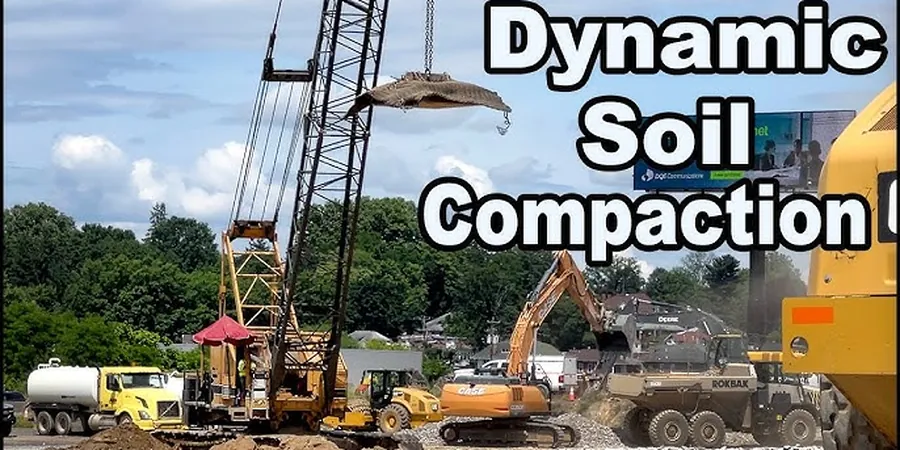
Illustrative image of Compactacion dinamica in Toronto
For Toronto’s heterogeneous fills, dynamic compaction design must balance energy input against vibration limits to protect adjacent utilities and heritage structures.

Methodology and scope

A mid-rise residential project near the Gardiner Expressway required treatment of 8 m of loose sand fill overlying the Lake Iroquois sand bar. The dynamic compaction design sequence involved three phases: high-energy tamping with a 20-tonne weight dropped from 25 m, followed by low-energy ironing passes. Each drop grid was offset to achieve 80% relative density across the footprint. Verification used CPT soundings and seismic dilatometer tests before and after treatment. We also cross-checked the results with an SPT program to satisfy the geotechnical engineer’s QA/QC protocol. The final compaction achieved a modulus of subgrade reaction of 55 MPa/m, which allowed the structural designer to proceed with a raft foundation without deep piles.
Technical reference image — Toronto

Local considerations

The predominant glacial tills and Champlain Sea clays in Toronto exhibit high stiffness but can mask deeper soft zones or discontinuous sand lenses. A dynamic compaction design that ignores these layers risks differential settlement exceeding 25 mm under service loads. Vibration monitoring is mandatory near the TTC subway tunnels and heritage building foundations; peak particle velocity must stay below 12 mm/s per Toronto Municipal Code Chapter 363. We address this by pre-modelling wave attenuation using site-specific shear wave velocity profiles obtained from MASW surveys. This allows us to adjust the drop sequence and energy levels before mobilising equipment, reducing the likelihood of damage claims or construction delays.

Need a geotechnical assessment?

Reply within 24h.

Email: contact@geotechnicalengineering.co

Technical parameters

ParameterTypical value
Energy per drop (tonne-metres)300 – 600
Grid spacing (m)4.0 – 7.0
Depth of improvement (m)6.0 – 12.0
Target relative density (%)75 – 85
Pre-treatment CPT qc (MPa)2.0 – 8.0
Post-treatment CPT qc (MPa)8.0 – 20.0

Associated technical services

01

Compaction Energy Optimisation

We calculate the optimum drop weight, height, and grid spacing based on site-specific soil stratigraphy and target density parameters.

02

Vibration Monitoring & Control

Continuous PPV recording with geophones at multiple distances ensures compliance with Toronto’s municipal vibration limits and protects adjacent structures.

03

Pre- and Post-Treatment Testing

CPT, SPT, and seismic dilatometer tests before and after treatment confirm that design targets have been met and provide data for foundation design.

04

Settlement Performance Verification

We install settlement plates and inclinometers to monitor post-construction consolidation, comparing actual behaviour against the design predictions.

Applicable standards

NBCC 2020 – Part 4 Foundations, CSA A23.2-9A / CSA A23.2-9A / CSA A23.2-9A / CSA A23.2-9A / CSA A23.2-9A / ASTM D1586 (SPT correlation), Canadian Foundation Engineering Manual 4th Ed., CSA A23.3-19 (structural design verification)

Frequently asked questions

What is the typical depth of improvement achievable with dynamic compaction in Toronto’s soils?

In Toronto’s granular fills and sand deposits, dynamic compaction can achieve effective depths of 6 to 12 metres. Denser glacial till requires higher energy drops and may limit improvement to 8 metres. The exact depth depends on the weight and drop height selected during design.

How does dynamic compaction interact with Toronto’s high water table near the lake shore?

A high water table reduces the efficiency of dynamic compaction because water pressure dissipates impact energy. In areas like the Port Lands or Mimico, we often specify pre-treatment dewatering or a surcharge stage to lower the phreatic surface before tamping begins. Post-treatment drainage layers may also be required.

What is the cost range for dynamic compaction design and execution in Toronto?

For a typical mid-rise site in Toronto, the design and verification programme ranges between CA$1.470 and CA$5.470. This includes the energy optimisation study, pre- and post-treatment testing, and vibration monitoring. Larger sites with complex stratigraphy or tight vibration limits may reach the upper end of this range.

Location and service area

We serve projects across Toronto and its metropolitan area.

View larger map