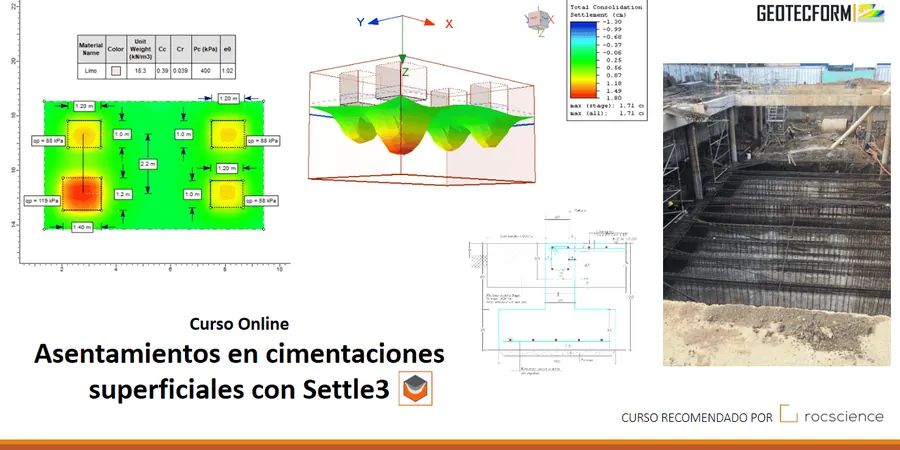
Toronto's growth since the 1970s has pushed development onto former lake beds, river valleys, and reclaimed industrial land. The city's subsurface varies dramatically from dense glacial till in the north to soft lacustrine clays and silts along the lake shore. A settlement analysis in Toronto must account for this variability. We have assessed dozens of sites across the GTA, from the Don Valley to the waterfront, and know where differential settlement is most likely. Before designing foundations on compressible strata, we recommend a geotechnical site investigation to profile soil layering and identify problematic zones. Our team uses local geotechnical data and borehole records to build reliable models.
Toronto's soft Leda clay and lacustrine silts can settle 50–100 mm under modest loads if pre-consolidation stress is exceeded. Our analysis identifies that threshold.
Methodology and scope
A recent project in the Port Lands required settlement analysis for a 15-story residential tower on 15 meters of soft clay. We combined consolidation testing with numerical modeling. The key parameters we evaluate include pre-consolidation pressure, compression index (Cc), recompression index (Cr), and coefficient of consolidation (Cv). For shallow foundations on till, we check immediate elastic settlement using Young's modulus from SPT correlations. When the soil profile shows interbedded sand lenses, we also run CPT soundings to capture continuous stratigraphy. Our approach follows NBCC 2020 and CSA A23.3 provisions for differential settlement limits. Each analysis delivers allowable bearing pressure, predicted total settlement, and time-rate of consolidation.
Technical reference image — Toronto
Local considerations
Toronto sits at an elevation of 76 m above sea level, with a water table often 2–4 m below grade in low-lying areas. The city's clay deposits, particularly the Leda clay found in parts of Scarborough and the waterfront, are sensitive to remolding and can lose strength when disturbed. A settlement analysis in Toronto that ignores these effects risks structural damage. We incorporate post-construction settlement from live loads, as well as long-term creep in clay. Our reports highlight settlement-sensitive zones and recommend appropriate foundation depths or ground improvement to keep total movement within code limits.
One-dimensional consolidation analysis using oedometer tests and SPT correlations. Output includes total settlement, differential settlement, and time-rate curves. Suitable for low- to mid-rise buildings on shallow foundations.
02
Advanced 2D/3D FEM Settlement Modeling
Finite element analysis using Plaxis or RS2 for complex geometries, adjacent excavation effects, and layered profiles. We model staged construction and soil-structure interaction for high-rise towers and deep basements.
03
Settlement Monitoring & Verification
Installation of settlement plates, inclinometers, and piezometers. Real-time data logging with monthly reporting to compare measured vs. predicted movement. Essential for waterfront projects and sensitive existing structures.
04
Ground Improvement Design for Settlement Control
When predicted settlement exceeds allowable limits, we design preloading with surcharge, vertical drains, or stone columns. Each solution is calibrated to Toronto's clay compressibility and project schedule.
Applicable standards
NBCC 2020 – National Building Code of Canada (clause 4.1.3.7 on differential settlement), CSA A23.3-19 – Design of concrete structures (limits for foundation movement), CSA + CSA + CSA + CSA + ASTM D2435 (also CFEM Ch 2) (also CFEM Ch 2) (also CFEM Ch 2) (also CFEM Ch 2) (also CFEM Ch 2) – Standard test methods for one-dimensional consolidation of soils, ASTM D4546 (CFEM Ch 4) (CFEM Ch 4) (CFEM Ch 4) (CFEM Ch 4) (CFEM Ch 4) – One-dimensional swell or settlement of cohesive soils
Frequently asked questions
How long does a settlement analysis typically take for a Toronto project?
For a standard residential or commercial site, we complete the analysis within 10–15 business days after receiving laboratory consolidation test results. Complex FEM modeling for high-rises or adjacent excavation scenarios may require 3–4 weeks. We prioritize projects with tight municipal approval timelines.
What parameters do you need from the soil lab to run a settlement analysis?
We require the pre-consolidation pressure (σp), compression (Cc) and recompression (Cr) indices, coefficient of consolidation (Cv), and natural water content from undisturbed samples. For shallow foundations on till, SPT N-values and Young's modulus correlations suffice. We also need the site groundwater depth.
How does settlement analysis differ for brownfield sites in Toronto's waterfront?
Brownfield sites often have fill layers with variable compaction and organic content. We run additional tests like organic content (ASTM D2974 (CFEM Ch 4) (CFEM Ch 4) (CFEM Ch 4) (CFEM Ch 4) (CFEM Ch 4)) and collapse potential (ASTM D5333 (CFEM Ch 4) (CFEM Ch 4) (CFEM Ch 4) (CFEM Ch 4) (CFEM Ch 4)). The analysis accounts for long-term decomposition settlement and chemical softening from groundwater flow. We also check for differential settlement across fill–natural soil interfaces.
What is the typical cost range for a settlement analysis in Toronto?
For a standard project with one borehole and three oedometer tests, the fee ranges between CA$950 and CA$2,240. This includes the analysis report, consolidation curves, and time-rate predictions. Complex FEM models or multi-borehole projects will be higher. We provide a fixed-price quote after reviewing the scope.
Location and service area
We serve projects across Toronto and its metropolitan area.