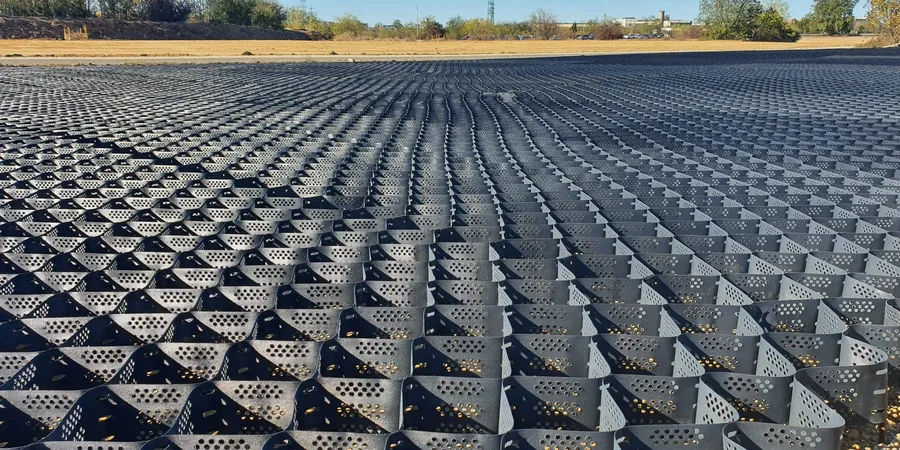
Toronto sits on the Iroquois shoreline and the former Lake Iroquois basin, so the top 10 to 15 meters of soil can shift from dense glacial till to soft clay in just a few blocks. That variability makes geocell design a practical choice for load support and slope stabilization across the city. By confining granular infill within a three-dimensional honeycomb structure, we distribute loads more evenly over weak subgrades. This technique is especially useful on projects near the Don Valley or the Scarborough Bluffs where erosion and soil creep are constant concerns. Before finalizing a geocell layout, we typically run a resistivity survey to map subsurface anomalies, then cross-check with a compaction control plan to ensure the base layer meets density targets.
A 150 mm geocell layer confined with angular gravel can replace 300 mm of unbound base on soft Toronto clay.
Methodology and scope
We use geocells made from high-density polyethylene (HDPE) with a typical cell depth of 100 to 200 mm and a welded seam strength of at least 10 kN/m per ASTM D4885. The panels are expanded on site, pinned to the prepared subgrade with steel anchors, and then filled with gravel, sand or recycled aggregate. In Toronto, where the water table is shallow in areas like the lower Don River valley, we prefer a coarse angular fill that drains well and locks into the cell walls. The confinement effect increases the apparent cohesion of the infill, so a 150 mm geocell layer can carry loads that would otherwise require 300 mm of unbound granular base. The installation is straightforward:
Grade and compact the subgrade to 95% Standard Proctor density.
Expand the geocell panels and secure with perimeter anchors.
Fill and compact in lifts not exceeding the cell depth.
Technical reference image — Toronto
Local considerations
The main risk when designing geocells in Toronto is underestimating the water content in the underlying clay. The city's average annual rainfall is about 830 mm, and the glacial till that looks stable in summer can soften quickly after a wet fall. If the subgrade saturates before the geocell is filled, the confining effect drops and the cells may bulge or tear at the seams. Another concern is the freeze-thaw cycle: Toronto gets roughly 60 freeze-thaw events per year, so the infill must be free-draining to prevent ice lens formation within the cell. We always specify a geotextile separator beneath the geocell when the subgrade CBR is below 3, and we require a minimum of 150 mm of granular cover in frost-susceptible zones.
Angular gravel 19–38 mm, sand or recycled crushed concrete
Base reinforcement ratio
Up to 2.5:1 vs. unbound aggregate
Slope angle limit
1:1 (45°) with proper edge restraint
Seam peel strength
≥ 6 kN/m (ASTM D4885)
Associated technical services
01
Slope Stabilization with Geocells
For slopes steeper than 2H:1V on the Niagara Escarpment or in parkland near the Humber River, we design geocell systems that hold topsoil and prevent surface erosion. The cells are filled with a sandy loam mix that supports vegetation while the geocell provides immediate tensile restraint. We anchor the bottom row with 600 mm steel stakes and tie the top edge into a drainage swale or berm.
02
Load Support for Access Roads and Laydown Yards
Construction sites in Toronto's Port Lands or near the lakeshore often face soft silty clay with CBR values below 2. We design geocell-reinforced access roads that spread the axle loads of dump trucks and concrete mixers over the weak subgrade. The sections are typically 200 mm deep, filled with 25 mm crushed limestone, and covered with a geotextile to separate from the base course.
What is the typical cost for a geocell design in Toronto?
For a standard residential access road or small slope project, the design and specification work ranges between CA$1,260 and CA$3,140. This includes a site visit, subgrade evaluation, cell depth and infill recommendation, and a stamped drawing for permit. Large commercial sites may fall above this range due to additional testing.
How deep should the geocell be for a driveway on clay soil?
For clay subgrade with a CBR of 2 to 3, a 150 mm deep geocell filled with 25 mm angular gravel is usually sufficient for passenger vehicles. If you expect garbage trucks or delivery vans, we recommend 200 mm cells with a geotextile separator and a 100 mm granular wearing course on top.
Can geocells be used on slopes in Toronto's ravine areas?
Yes, but the slope must be benched into the existing soil and the geocell anchored with 500 mm U-shaped staples at 1 m spacing. For slopes above 3 m in height, we also require a drainage layer behind the cells to prevent hydrostatic pressure buildup. The system works well on the Don Valley ravines where topsoil is shallow and erosion is active.
What infill material works best in freeze-thaw conditions?
Angular crushed stone (25–38 mm) with less than 5% fines is the most freeze-thaw resistant infill for Toronto's climate. The angular particles interlock within the cells and the high void ratio allows water to drain before it freezes. Sand and recycled concrete also work but may need a thicker cover layer to prevent frost heave in the underlying clay.
Location and service area
We serve projects across Toronto and its metropolitan area.