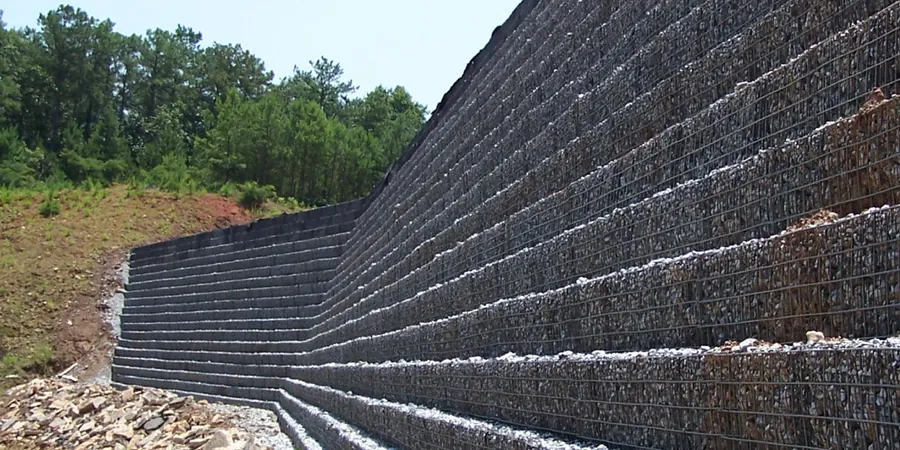
We recently worked on a project near the Don Valley Parkway where a six-meter-high retaining wall was needed for a commercial development. The site had variable fill layers over glacial till, a common profile in Toronto. Instead of a conventional reinforced concrete wall, we proposed a mechanically stabilized earth (MSE) wall design. The approach uses granular backfill with geosynthetic or metallic reinforcements, creating a cost-effective and flexible structure. For that particular site, we first ran a resistividad eléctrica SEV survey to map the soil stratification and identify any buried utilities. The MSE wall design integrates these soil conditions with the reinforcement layout to ensure long-term stability under both static and seismic loads.
MSE wall design in Toronto requires careful consideration of glacial till variability and seasonal freeze-thaw cycles to ensure long-term performance.
Methodology and scope
Our MSE wall design process in Toronto typically begins with a detailed site investigation. We mobilize a track-mounted drill rig to collect undisturbed samples from the proposed wall alignment. The samples are tested in our ISO 17025-accredited lab for grain size distribution, Atterberg limits, and direct shear strength. These parameters directly inform the reinforcement spacing and length. For example, a silty sand with fines content above 15% may require geotextile wraps rather than metallic strips to prevent corrosion. We also perform compaction control using a nuclear density gauge to verify that the backfill achieves at least 95% of the standard Proctor maximum dry density. This attention to detail is why our estudio de mecánica de suelos reports are trusted by Toronto engineers for MSE wall certification.
Technical reference image — Toronto
Local considerations
Toronto sits on the south shore of Lake Ontario, with a population approaching three million. The city lies in a moderate seismic zone, with a peak ground acceleration of about 0.2g per the NBCC 2020. This is low compared to Vancouver, but it still matters for MSE wall design. A 30-meter-high wall in Scarborough could experience lateral spreading if the underlying clay liquefies during a rare event. We always check the cyclic resistance ratio against the cyclic stress ratio using the simplified procedure by Seed and Idriss. If the factor of safety drops below 1.1, we recommend a stone column or deep drainage system behind the wall to mitigate pore pressure buildup.
We conduct boreholes, test pits, and laboratory testing to determine soil strength, groundwater levels, and reinforcement pullout resistance. Our reports include detailed stratigraphic profiles and design parameters tailored to your wall geometry.
02
Reinforcement Layout and Stability Analysis
Using limit equilibrium software (SLOPE/W and ReSSA), we optimize reinforcement length and vertical spacing. We evaluate internal, external, and compound failure modes under static and seismic conditions per AASHTO LRFD.
Applicable standards
NBCC 2020 (National Building Code of Canada), CSA A23.3-19 (Concrete Design), AASHTO LRFD Bridge Design Specifications (8th Ed.), ASTM D5321 (Direct Shear Test for Geosynthetics)
Frequently asked questions
What is the typical cost range for MSE wall design in Toronto?
For a standard commercial project, expect to invest between CA$1.880 and CA$7.130. This covers the geotechnical investigation, laboratory testing, reinforcement design, and a stamped report. The final cost depends on wall height, soil conditions, and the number of boreholes required.
How does frost penetration affect MSE wall design in Toronto?
Toronto experiences frost depths of 1.2 to 1.5 meters. We design the wall foundation to sit below this line to prevent frost heave beneath the base. The backfill zone is drained with a perforated pipe at the toe, and we specify granular fill with less than 5% fines to avoid ice lens formation within the reinforced zone.
Can MSE walls be built on soft clay in Toronto?
Yes, but they require ground improvement first. The glacial till that underlies most of Toronto is competent, but the Lake Iroquois clay deposits in the central and eastern areas can be soft. We often recommend wick drains or lightweight fill to reduce settlement before placing the MSE wall backfill. A staged construction approach with settlement monitoring is standard practice.
What reinforcement type works best for Toronto's soil conditions?
It depends on the backfill corrosivity. Toronto's native till is typically non-aggressive, so galvanized steel strips are common for walls up to 10 meters. For taller walls or sites with sulfate-rich groundwater (near old landfills), we switch to polyester geogrids. We always run a pH and resistivity test on the backfill before selecting the reinforcement.
Location and service area
We serve projects across Toronto and its metropolitan area.