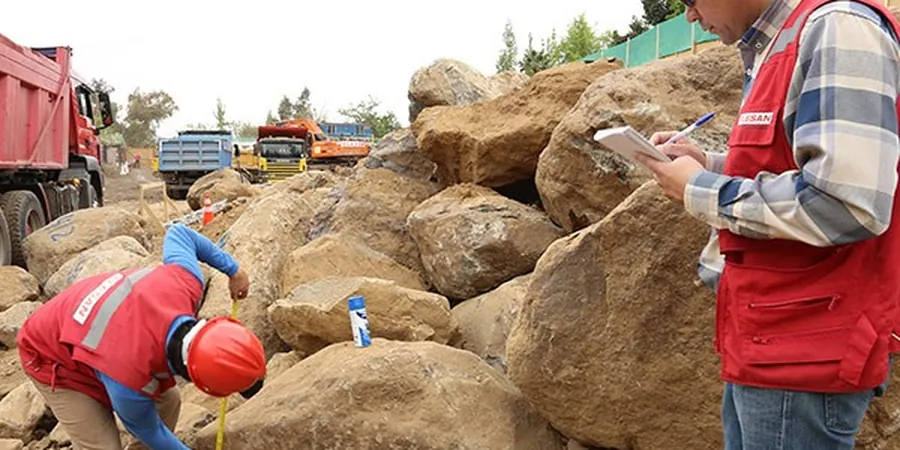
Toronto's deep glacial till and clay deposits demand rigorous soil mechanics study before any foundation design. The city sits on a sequence of glaciolacustrine clays, silty sands, and shale bedrock that varies significantly between downtown and the suburbs. We have seen buildings in the Yorkville area that required soil mechanics study to evaluate settlement in the highly plastic clay, while on the Scarborough Bluffs the sand layers demand slope stability analysis. Before mobilizing a drill rig, our team correlates existing borehole data from the Ontario borehole database with the project footprint. This step reduces the number of test pits needed and lowers field costs. We then execute a targeted soil mechanics study that defines soil stratigraphy, groundwater conditions, and strength parameters for each design layer.
Toronto's glaciolacustrine clay can settle up to 40 mm under a 12-story building without proper soil mechanics study and ground improvement.
Methodology and scope
A recent mid-rise project on Yonge Street near Eglinton required a soil mechanics study to design a 12-meter deep basement. The building footprint sat on the Lower Bay Street clay, a soft silty clay up to 18 meters thick. We installed five boreholes to 30 meters depth and retrieved undisturbed Shelby tube samples. The lab program included consolidation tests to predict settlement under the new load and triaxial CU tests to define undrained shear strength. For the temporary shoring design, we combined the soil mechanics study results with a resistivity survey to map the bedrock surface and avoid costly over-excavation of shale. The final geotechnical report recommended a mat foundation on improved ground using stone columns to reduce total settlement below 25 mm.
Technical reference image — Toronto
Local considerations
Toronto is located in a moderate seismic zone (seismic hazard index 0.12g for firm ground per NBCC 2020). The major risk is liquefaction of loose sand lenses within the glacial till, especially south of Bloor Street where the Don River valley deposits exist. A soil mechanics study must include cyclic triaxial tests on these sand layers to evaluate the cyclic resistance ratio. Without this evaluation, a seismic event could trigger differential settlement or lateral spreading. We have identified loose sand pockets at 6 to 10 meters depth in the Port Lands area that would require ground densification prior to any structural load.
Hollow-stem auger drilling to 30 m depth with continuous split-spoon sampling for SPT N-values. Shelby tube sampling in clay layers for lab consolidation and triaxial tests.
02
Laboratory Strength and Consolidation Tests
Triaxial CU and UU tests, oedometer consolidation, Atterberg limits, and grain size distribution. All tests performed under ISO 17025 accreditation.
03
Geotechnical Report and Foundation Recommendations
Comprehensive report including soil profile, groundwater conditions, bearing capacity, settlement estimates, and seismic site classification per NBCC.
Applicable standards
NBCC 2020 (National Building Code of Canada) – seismic and foundation design, CSA A23.2-9A / CSA A23.2-9A / CSA A23.2-9A / CSA A23.2-9A / CSA A23.2-9A / ASTM D1586 – Standard Test Method for Standard Penetration Test (SPT), CSA + CSA + CSA + CSA + ASTM D2850 (also CFEM Ch 2) (also CFEM Ch 2) (also CFEM Ch 2) (also CFEM Ch 2) (also CFEM Ch 2) – Unconsolidated-Undrained Triaxial Test on Cohesive Soils, CSA A23.3-19 – Design of Concrete Structures (foundation portions), CSA + CSA + CSA + CSA + ASTM D2435 (also CFEM Ch 2) (also CFEM Ch 2) (also CFEM Ch 2) (also CFEM Ch 2) (also CFEM Ch 2)/D2435M-11 – One-Dimensional Consolidation Properties of Soils
Frequently asked questions
How much does a soil mechanics study cost in Toronto?
For a typical mid-rise building (5 to 8 boreholes, 4 to 5 lab tests each), the cost ranges between CA$4,000 and CA$7,730. This includes drilling, sampling, lab testing, and a final geotechnical report. Larger projects with deeper boreholes or specialized testing like cyclic triaxial can exceed this range.
What is the difference between N-SPT and undrained shear strength?
N-SPT measures the resistance of soil to a standard split spoon driven by a 63.5 kg hammer dropping 760 mm. It is a field index of relative density in sands. Undrained shear strength (Su) is a design parameter for clays obtained from triaxial or vane tests. The two parameters are not interchangeable; N-SPT is used for granular soils, Su for cohesive soils.
Do I need a soil mechanics study for a basement renovation in Toronto?
Yes, if the basement exceeds 1.2 m depth below grade or is located within the Lake Iroquois plain (most of Toronto south of Eglinton). The NBCC requires a geotechnical investigation for any excavation that may affect adjacent structures. A shallow study with 2 boreholes to 8 m depth is usually sufficient for a single-family basement.
What are the typical soil layers found in downtown Toronto?
From top down: fill (0.5-2 m), Lake Iroquois clay (5-18 m), glacial till (silty sand with gravel, 2-10 m), and Georgian Bay shale bedrock. The clay is highly plastic (PI 25-45%) and compressible. The glacial till has SPT N-values of 20-50. The bedrock surface varies from 5 m near the lake to 30 m near the escarpment.
Location and service area
We serve projects across Toronto and its metropolitan area.