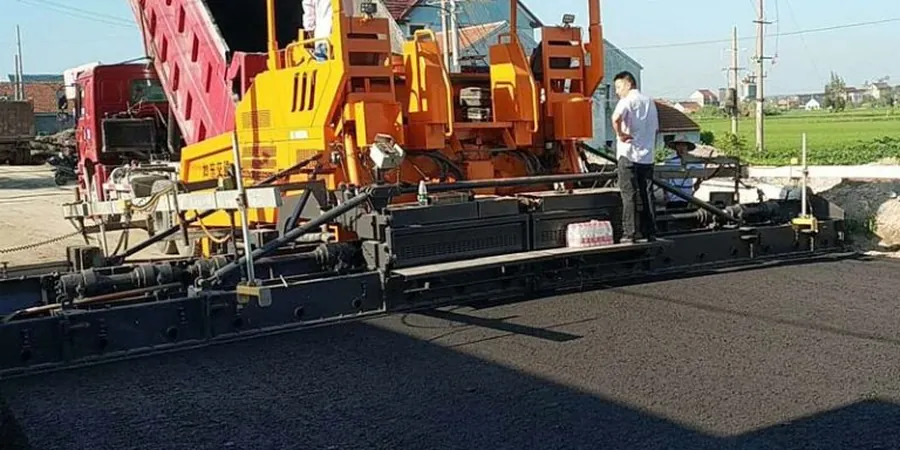
In Toronto, flexible pavement design must comply with the Ontario Provincial Standards (OPSS 310) and the MTO Pavement Design Manual. The city's freeze-thaw cycles and variable subgrade conditions make proper structural layer design critical for long-term performance. Our team applies the AASHTO 1993 empirical method, calibrated with local traffic load spectra and soil CBR values from site-specific testing. Before designing, we coordinate with geocell reinforcement when subgrade California Bearing Ratio falls below 3%, a common scenario in Toronto's glacial till deposits. Every design integrates drainage analysis and seasonal frost penetration to prevent premature cracking or rutting.
Flexible pavement design in Toronto must account for frost heave potential, low subgrade CBR, and asphalt binder grade selection for freeze-thaw cycles.
Methodology and scope
A typical Toronto parking lot design starts with a subgrade evaluation using DCP and plate load tests. We then select asphalt binder grade PG 64-28 for local climate, set the hot mix asphalt thickness between 90 and 150 mm depending on traffic class, and specify a granular base layer of 200 to 400 mm. Key parameters include:
Design traffic (ESALs) from 0.05 to 10 million equivalent single axle loads
Subgrade resilient modulus (Mr) from 15 to 45 MPa
Reliability level of 90% for local roads
Each design includes a structural number calculation using layer coefficients from the AASHTO guide, and we model fatigue and rutting performance with the AASHTOWare software.
Technical reference image — Toronto
Local considerations
Toronto's clay and silt subgrades often have low drainage capacity. If the design ignores the water table rise during spring thaw, the base layer can saturate and lose support. Another common issue is underestimating traffic growth: a residential street that receives delivery trucks can accumulate ESALs well above the original estimate. We always recommend a subgrade improvement using geocells or a drainage blanket when the water table is within 1.5 m of the surface. Without these measures, pavement life can drop by 40% in 5 years.
Field and laboratory CBR tests, DCP profiling, and resilient modulus determination to characterize the subgrade support for flexible pavement design.
02
Traffic Load Analysis and ESAL Calculation
Traffic classification per OPSS 310, axle load spectra from local counts, and ESAL calculation for design life up to 20 years.
03
Structural Pavement Design Report
Complete design report with layer thickness, material specifications, drainage recommendations, and construction QA/QC guidelines.
04
Pavement Rehabilitation and Overlay Design
Evaluation of existing pavement condition, remaining life assessment, and design of hot-mix asphalt overlays or full-depth reclamation.
Applicable standards
OPSS 310 – Pavement Design for Municipal Roads, ASTM D1557 (also CFEM Ch 2) (also CFEM Ch 2) (also CFEM Ch 2) (also CFEM Ch 2) (also CFEM Ch 2) – Modified Proctor for compaction, AASHTO T 307 – Resilient modulus of subgrade, MTO Pavement Design and Rehabilitation Manual
Frequently asked questions
What is the typical cost range for flexible pavement design in Toronto?
For a standard residential street or parking lot design, the cost ranges between CA$2,620 and CA$6,400, depending on the number of sections, traffic data requirements, and subgrade testing needed. This includes field investigation, lab testing, and a full design report.
Which asphalt binder grade is recommended for Toronto's climate?
The Ontario Ministry of Transportation recommends PG 64-28 for the Greater Toronto Area. This binder provides adequate high-temperature rutting resistance in summer and low-temperature crack resistance during winter freeze-thaw cycles. For high-traffic intersections, PG 70-28 may be specified.
How does the design account for frost heave in Toronto?
The AASHTO 1993 method incorporates a frost depth adjustment. For Toronto, the design frost penetration is typically 1.2 to 1.5 m. We specify a granular base layer thickness that exceeds the frost depth, or use a drainage layer (geotextile and granular) to prevent ice lens formation. Subgrade soils with high plasticity (PI > 20) require special attention.
Location and service area
We serve projects across Toronto and its metropolitan area.