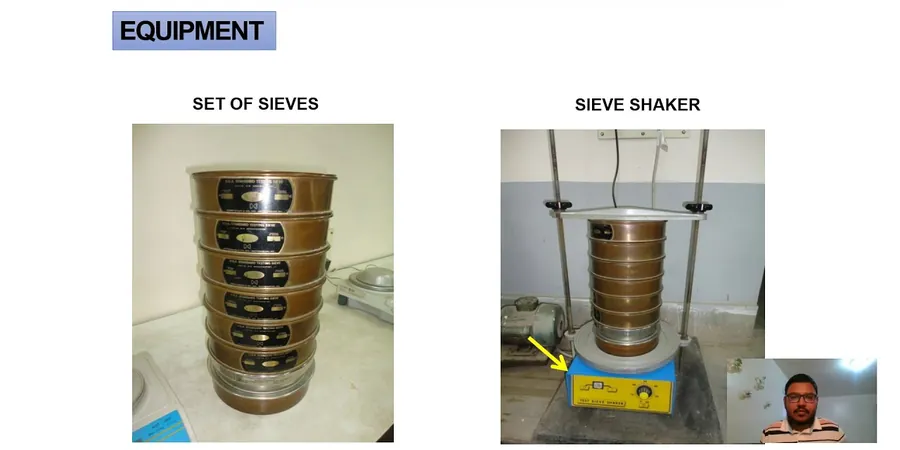
We run the grain size analysis on a standard set of sieves stacked on a mechanical shaker, with the hydrometer taking over for the silt and clay fractions that pass the No. 200 sieve. In Toronto, where glacial till overlays lacustrine clay in many areas north of Bloor Street, the combination of sieving and sedimentation gives us a complete picture of the particle-size distribution. Before we start, the sample is oven-dried and weighed, then washed through the nest of sieves to remove fines. The hydrometer test then tracks the settling velocity of particles suspended in a dispersant solution over 24 hours, which is critical for characterizing the deep clay layers found in the Don Valley and along the lake shore. This data feeds directly into the Unified Soil Classification System and helps engineers decide whether a site needs a resistivity survey to assess corrosion potential or a full geotechnical investigation.
The hydrometer test tracks settling velocity over 24 hours, critical for characterizing deep clay layers found in the Don Valley and along the lake shore.
Methodology and scope
The difference between soils in Scarborough and Etobicoke is striking. Scarborough often has dense glacial till with less than 15% fines, while Etobicoke contains thicker deposits of soft clay that can exceed 40% passing the No. 200 sieve. That contrast makes the hydrometer phase essential for the western part of Toronto. Our procedure follows CSA + CSA + CSA + CSA + ASTM D422 (also CFEM Ch 2) (also CFEM Ch 2) (also CFEM Ch 2) (also CFEM Ch 2) (also CFEM Ch 2) for the hydrometer and ASTM D6913 for the sieve portion, using a 0.5% sodium hexametaphosphate solution as dispersant and checking the meniscus correction for each reading. The results are plotted on a semi-logarithmic graph showing percent finer versus particle diameter, from which we report D10, D30, D60, the coefficient of uniformity, and the coefficient of curvature. These parameters become the basis for estimating hydraulic conductivity, frost susceptibility, and suitability for engineered fill under the Ontario Building Code.
Technical reference image — Toronto
Local considerations
Over 2.8 million people live in Toronto, and much of the city sits on former lakebeds and river valleys where the soil gradation changes within meters. A common mistake we see is relying only on sieve analysis for a site underlain by the Halton Till. That till contains a wide range of particle sizes, and without the hydrometer you miss the fines that control drainage and compressibility. The result can be an overestimated bearing capacity or a poorly designed drainage system that leads to settlement. For projects near the Humber River or the Don River, where alluvial deposits include silty sand and organic silt, the hydrometer is non-negotiable. The NBCC 2020 requires site class determination based on soil type, and grain size data directly influences whether a site is classed as C, D, or E for seismic design.
For gravels and sands with minimal fines, we perform dry sieving on a full nest from 75 mm down to 0.075 mm. This is the standard method for pavement subgrades and granular base materials across Toronto.
02
Wet Sieve Plus Hydrometer (Fine Soils)
When fines content exceeds 10%, we wash the sample through the No. 200 sieve and run the hydrometer on the wash water. This combined method is required for clays and silts typical of the Lake Iroquois shoreline deposits.
03
Particle Size Distribution Report
Each test produces a certified report with the gradation curve, tabulated data, and derived parameters (Cu, Cc, D10, D30, D60). Reports are formatted for submission under the Ontario Building Code and can be integrated with as-settlement analysis.
04
Gradation for Filter Design
We tailor the test to provide the grain size data needed for filter and drain design, including the D15/D85 ratio for geotextile selection. This is especially relevant for retaining walls and below-grade structures in Toronto's high water table areas.
Applicable standards
CSA + CSA + CSA + CSA + ASTM D422 (also CFEM Ch 2) (also CFEM Ch 2) (also CFEM Ch 2) (also CFEM Ch 2) (also CFEM Ch 2) (Standard Test Method for Particle-Size Analysis of Soils), ASTM D6913-17 (Standard Test Methods for Particle-Size Distribution of Soils Using Sieve Analysis), ASTM D7928-17 (Standard Test Method for Particle-Size Distribution of Soils by Hydrometer Analysis), Ontario Regulation 332/12 (Building Code, Part 4 — Site Characterization)
Frequently asked questions
How much does grain size analysis cost in Toronto?
The typical range for a combined sieve and hydrometer test in Toronto is CA$160 to CA$280, depending on sample quantity and whether you need expedited results. Bulk discounts apply for projects with five or more samples.
What is the difference between sieve and hydrometer analysis?
Sieve analysis separates particles down to 0.075 mm using mechanical sieves. The hydrometer test measures particles finer than 0.075 mm by tracking their sedimentation rate in a water column. Both are needed for soils with significant fines content, which is common in Toronto's clay deposits.
How long does a grain size analysis take?
A standard sieve analysis can be completed in one day. When hydrometer is required, the test runs for 24 hours because sedimentation readings are taken at specific intervals up to 24 hours. We typically deliver the full report within three to five business days.
What soil types in Toronto require hydrometer testing?
Any site underlain by the deep clay and silt deposits of the Lake Iroquois plain or the Don Valley alluvium needs hydrometer testing. If more than 10% of the soil passes the No. 200 sieve during washing, we recommend adding the hydrometer to get a complete gradation.
Location and service area
We serve projects across Toronto and its metropolitan area.